Finger-Jointed
Solid Wood
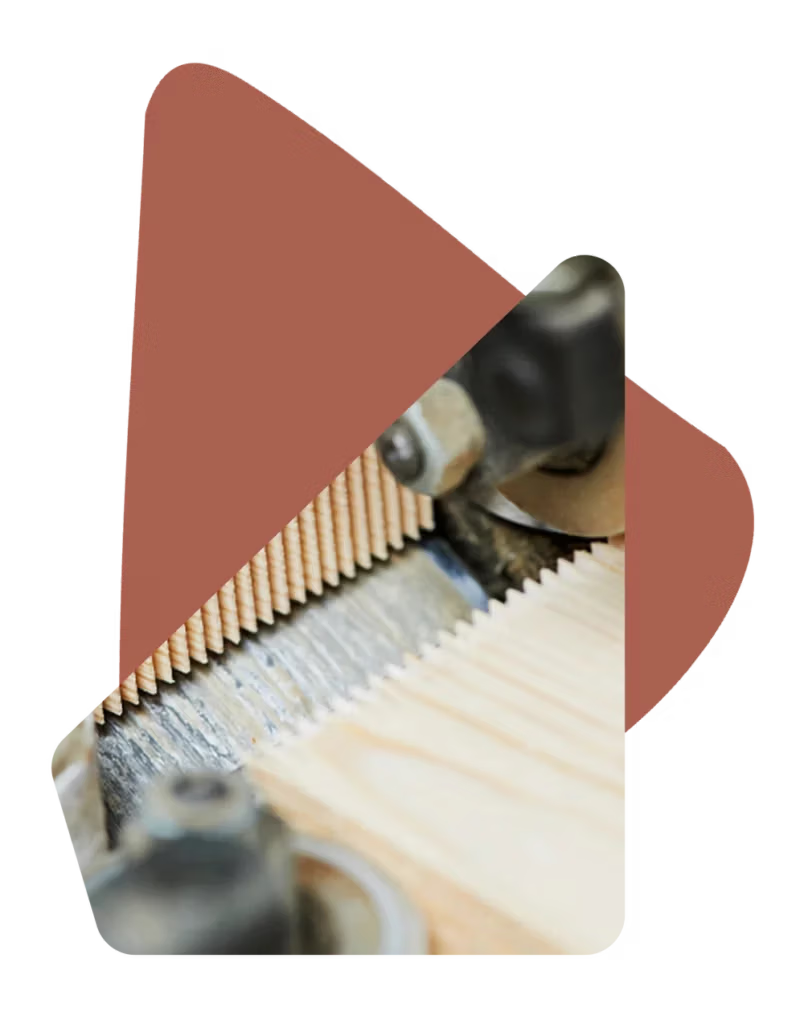
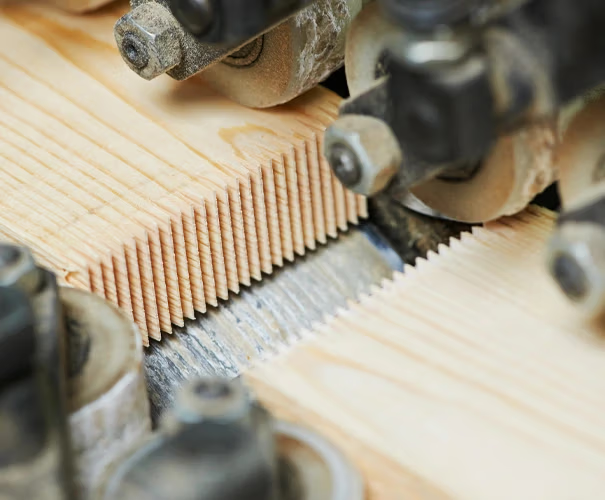
Our Finger-Jointed Solid Wood (BMA) is assembled using a self-locking technique. This produces homogeneous products perfectly suited for structural applications. Our BMA thus combines the traditional look of solid wood with controlled performance, both in construction and prefabrication.
French softwood (PEFC certified)
Finger-jointing
Long & straight timber
Planed 4 sides & chamfered
Structural use
Our Finger-Jointed Solid Wood
BMA provides long, consistent pieces adapted to modern structural requirements.
We manufacture finger-jointed timber with rectangular or square sections using a glued finger-jointing process.
AVAILABLE SPECIES:
Douglas fir
Spruce
TECHNICAL SPECIFICATIONS:
Available lengths 13m
Planed 4 sides with chamfered edges
Mechanical strength class: C24
Wood from sustainably managed forests (PEFC certification)
Heights: 80 to 240 mm
Bonding with MUF-type adhesive, compliant with EN 301
Thicknesses: 45 to 120 mm
Framing & walls
BMA is commonly used for wall framing, in new builds as well as extensions or renovations.
Applications: BMA timber frame walls, vertical framing, studs and rails.
Purlins & rafters
Thanks to their long spans, BMA effectively replaces solid purlins and rafters.
Applications: purlins, rafters, roofing elements.
Prefabricated beams
BMA is widely used in prefabrication workshops, particularly for I-beam flanges or prefabricated structural elements.
Applications: I-beam flanges, structural modules, prefabricated panels.
Main applications & uses
Download our catalogue
Would you like to view all available sections and packaging?
Complete mastery of Finger-Jointed Solid Wood
Our BMA is inspected to ensure consistent quality:
Quality controls (catalog sources)
- Quality of wood and adhesives
- Mechanical grading of lamellas
- Characterization of finger joints
- Destructive bending tests
Mechanical characteristics for calculation
- BMA sizing is carried out according to EUROCODE 5 (EC5)
- The characteristic stresses to be used are defined by NF EN 338
BMA offers an excellent compromise between the aesthetics of solid wood and the stability of engineered wood.
Why choose MS BOIS BMA?
French PEFC and Bois de France supply chain
Local, sustainable, traceable wood.
Wide variety of sections
Over 30 sections available + production of long lengths (up to 16 m).
Stability & precision
Planed 4 sides, chamfers, MUF bonding compliant with EN 301.
Controlled mechanical performance
C24 class, compliant with structural requirements.
Suitable for construction & prefabrication
Timber frame houses, purlins, rafters, I-beams, workshop modules.
Strict quality controls
Finger-joint testing, mechanical controls, certified adhesives.
Frequently Asked Questions
What is finger-jointed solid wood?
It is wood composed of lamellas assembled by glued finger joints, offering homogeneity, stability, and long lengths.
Which species do you use?
French Spruce and Douglas Fir, PEFC and Bois de France certified.
What sections are available?
Over thirty sections, from 45×95 mm to 120×240 mm.
What lengths of BMA do you offer?
Up to 13m, depending on the sections.
What is the mechanical class of your BMA?
Class C24.
What are the main uses?
Wall framing, purlins, rafters, I-beam flanges, prefabrication.
What quality controls do you perform?
Inspection of lamellas, adhesives, finger joints, and destructive bending tests.
Is your BMA suitable for workshop prefabrication?
Yes, they are specifically used for prefabricated elements and I-beam flanges.